

History
A brief history of the origin of Landmine and Cluster Munition Monitor and the ICBL-CMC.
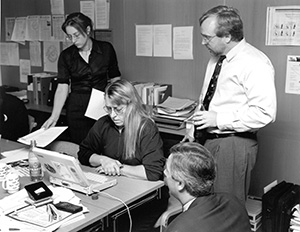
During the process to negotiate the treaty banning landmines (Mine Ban Treaty), the international community came to rely on the detailed and accurate information on the global mine and explosive remnants of war (ERW) problem that was provided by the International Campaign to Ban Landmines (ICBL). More information on the campaign's history is available on the main ICBL website.
After the Mine Ban Treaty was opened for signature in December 1997, the ICBL, in consultation with key government, international organization, and civil society partners, recognized the need for accurate and sustained reporting with respect to landmines, cluster munitions, and other ERW, and for monitoring the universalization and implementation of the Mine Ban Treaty.
The ICBL created Landmine Monitor in June 1998 to meet these monitoring and reporting needs, and the first annual report, Landmine Monitor Report 1999: Toward a Mine-Free World, was published to coincide with the First Meeting of States Parties to the Mine Ban Treaty in May 1999. Annual reports have since been published each year prior to the respective meeting of States Parties.
On 3 December 2008, the Convention on Cluster Munitions was opened for signature. In November 2008, the Monitor decided to monitor the universalization and implementation of the Convention on Cluster Munitions in addition to monitoring the Mine Ban Treaty, and published its first report on cluster munitions in May 2009. More information on the campaign's history is available on the main CMC website.
The initiative formally changed its name from Landmine Monitor to Landmine and Cluster Munition Monitor in December 2009 to better reflect its increased reporting of cluster munition issues. The Monitor produced three primary annual publications starting in 2010: Country Profiles, Cluster Munition Monitor, and Landmine Monitor. The Monitor also produces a series of thematic factsheets and, from 2013, Briefing Papers, to coincide with relevant treaty meetings.